Today marks the 35th anniversary of the day we lost Freddie, but rather than feeling sad (although it's really hard not to, even now), I'd like celebrate Freddie's short but fantastic career. Last summer I dedicated a week to his fabulous talent and in my retrospective I looked at Chico and the Man, his sole TV movie Million Dollar Ripoff (by the way, it's still streaming on Netflix and Hulu, so check out the links in the review) and the TVM biopic about his life titled Can You Hear the Laughter.
Freddie was a one of a kind talent, and someone I have adored for as long as I can remember. I'll be spending a little more time thinking about his smile today and I hope you do too.
Network: CBS Original Air Date: September 11th, 1979
Can You Hear the Laughter is based on Peter S. Greenberg’s 1977 Playboy article titled Good Night Sweet Prinze, which was adapted for television by Dalene Young (Dawn: Portrait of a Teenage Runaway) and it concentrates on the comedian’s heavy drug and depression problems. It is true that Prinze became one of the most infamous tragedies in Hollywood history, but he was also a delightful performer with a knack for showcasing stereotypes as inherently goofy, which took some of the sting out of them. Laughter concentrates on Prinze’s fall rather than his rise, and by hanging in the darker realm it does a grand disservice to Prinze, because it makes him seem utterly forgettable through the film’s blandness.
Angustain promotes the movie for People Magazine
The bright spot of Laughter is the cast, who put a lot of heart into their portrayals. Ira Angustain (The White Shadow) is a dead ringer for Prinze whom he idolized. In a 1979 interview with The St. Petersburg Times Angustain said, “When I heard they were going to do a movie about his life, I wanted the part more than anything else.” The California born Mexican American actor even joked with People Magazine in 1979, “Of course I had to learn a New York Puerto Rican accent for the part.” Angustain won the role over such Hollywood big names as Erik Estrada (!) and he does his best, but the character itself is rather one-sided. Randee Heller (SOAP) was especially good as Freddie’s kind secretary Carol, as was actor-turned-director Kevin Hooks who played Freddie's friend Nate.
However, Freddie’s mother, Maria Pruetzel was not pleased with Angustain and when referring to his imitation of Freddie’s standup, she said he was a “disaster.” She also felt the movie delved only into the darkness of Freddie’s life and she told The Calgary Herald that, “he took drugs, he was depressed. But they should have showed him going to his doctor sometimes trying to get help.” Freddie’s parents were actually omitted from the film, which made Maria feel like they were attempting to portray Freddie as “a kid brought up in the streets.” There is very little recreated footage of Chico and the Man as well, and Art Carney’s brother Fred took on the small role of Jack Albertson in the movie.
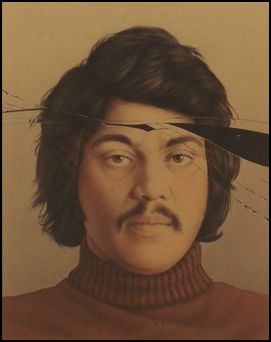
This painting by Alan Magee accompanied Greenberg's Playboy article
Angustain believed that “Freddie was a complicated man who wasn’t the happy go lucky guy he appeared to be in public,” but I think that somewhere between Greenberg’s nihilistic portrayal and Maria’s loving biography lies the real truth of Freddie’s rise and fall, and that’s the film I’d like to see (to be fair, I have not read Greenberg's article). Perhaps no other Hollywood star has risen so fast and fallen so quickly as Prinze’s and there is an important and moving story just waiting to be told, I just wish Laughter had been the film to tell it.
Chico (Freddie Prinze) was the fun loving Hispanic who charmed his way into the life of Ed Brown (Jack Albertson), an old bigoted curmudgeon who didn’t like the uprise of the ethnic population in his neighborhood. A drunk and a loner, Ed crankily put up with Chico, a kid he hated to admit he liked. Well, it’s not hard to like Chico, the sweet natured entrepreneur was determined to get old Ed some business into the rundown garage. The show focused on Chico and his ying/yang partnership with Ed, but there were lots of other characters filtering in and out of Ed and Chico’s life, including Louie (Scatman Crothers) and Della (Della Reese), plus all the quirky folks who made a pit stop in Ed’s garage. And, of course, hilarity ensued.
Prinze in his first scene in the pilot
I always thought Chico and the Man was created to showcase Freddie’s phenomenal standup act, but Prinze was actually up against four other actors for the part, including Isaac Ruiz who played Mando in several episodes. The final decision came to a meeting with Jack Albertson who was then starring in a stage production of the Sunshine Boys. The show’s creator, James Komack was interested in who Albertson had the most chemistry with. And a legend was born.
There was some controversy from the Mexican American community surrounding the casting of Prinze who was Puerto Rican. Prinze’s mother said in a book she wrote about her son, called The Freddie Prinze Story, that he would receive threats from angry TV viewers. Prinze responded in a 1975 interview with the Palm Beach Post with, “The feelings are the same. Spick means the same thing in New York as it does in Los Angeles. The pain is the same.” He conceded in the same interview, “I don’t think it’s the majority making the fuss. It’s a few radicals.” Eventually, the network bent and wrote in that Chico’s father was Puerto Rican. Regardless of the controversy, Chico and the Man was an instant hit, and Prinze was what they refer to in Hollywood as an overnight success.
Chico shows off his new digs
Many sitcoms of the 70s and 80s were far less sophisticated than what we see now. While people complain about the current state of the half hour comedy, those unaccustomed to the stage-like productions of yesteryear are sure to detest the format. It’s a shame too, because the simple sets and stories were a true showcase for the actors. Everything relied on presence and delivery and the comedy was derived from the actors’ ability to grab your interest. Freddie Prinze was a natural and he hit it right out of the ballpark in the pilot, which aired on September 13th, 1974 on NBC. Ed is introduced as a real cranky old bastard and it’s fun to watch Prinze warm the old coot’s heart. This of course would become the crux of the series, but it’s apparent here why the Man isn’t as keen on letting Chico go as he would like everyone to believe he is.
Chico does his own bargaining with God
The series ran fairly smoothly for three seasons while Prinze was experimenting with drugs and going deeper down the rabbit hole of depression. According to his mother, Prinze was lonely and not meant for the bright lights of Hollywood, but he would reveal to a psychologist shortly before his death about his own childhood sadness and how he began experimenting with drugs at a younger age than his mom talks about. He also confesses to an earlier suicide attempt (here’s a link to the article in People Magazine). Even now, with all I’ve learned about Prinze’s darker side, I find it hard to believe that what I saw on screen was so different from the man himself. By all accounts, Prinze was a good guy and well loved, but he obviously didn’t know how to take that love in, and all of that sadness was completely hidden on the series. Prinze actually taped his last episode just hours before his death. The episode was called Ed Talks to God and it aired on March 4th, 1977, about five weeks after Prinze’s death. This episode is especially poignant because it revolves around Ed’s birthday and many comments are made about how Ed should appreciate getting to the age he has. Prinze looks especially thin and his delivery does seem to be a bit off, but of course this is all in hindsight. Knowing he was so close to the end, makes it especially difficult to watch.
The chemistry between Albertson and Prinze was undeniable
For three magical seasons, Prinze brought the gift of laughter to just about everyone who ever watched an episode of Chico and the Man, and he shocked the country with his death. At Prinze’s funeral, Jack Albertson gave a eulogy which he ended with: “We are bound together, this family, not in a temporary chill of death, but in the everlasting warmth of his humanity and his humor. Let us not mourn his death, rather, let us celebrate his life. In the years to come, in the days and the years, this moment will have passed and we’ll see Freddie again, we will hear him, we will think of our brother and we will smile again and we will laugh again, and we will be warm again.”
The last time the gang appeared together
Six episodes of Chico and the Man are available on DVD at Amazon.
The series tried to continue without Prinze, and 12 year old Gabriel Melgar was brought in as a replacement. While I remember liking Melgar, who played Raul, the show was destined to bomb without Prinze. However, there were many poignant moments on the show, like when Ed busts up Chico's guitar in a fit of anger over his death. The following clips aptly capture the anger and sadness that not only Ed felt regarding the heavy loss of Chico, but also the frustation the fans endured as well. The fact that these scenes still resonate deeply proves the depth of the sense of loss we all shared when Freddie Prinze died.
Network: NBC Original Air Date: September 22nd, 1976
Freddie Prinze was a television star who was hoping to go onto bigger things like theatricals. While making a TV movie is more of a lateral move, Freddie saw it as a way to step out of his Chico image and give viewers something new. In his biography The Freddie Prinze Story, his mother says Prinze thought that Million Dollar Rip-Off was not such a great movie, but that he would get some good notice for it. According to her, he did indeed receive praise for this quirky heist comedy about a male con-artist who enlists four beautiful women to help him steal... you got it... a million dollars! OK, it’s actually 2.5 million, but you get the picture.
Lukin' good!
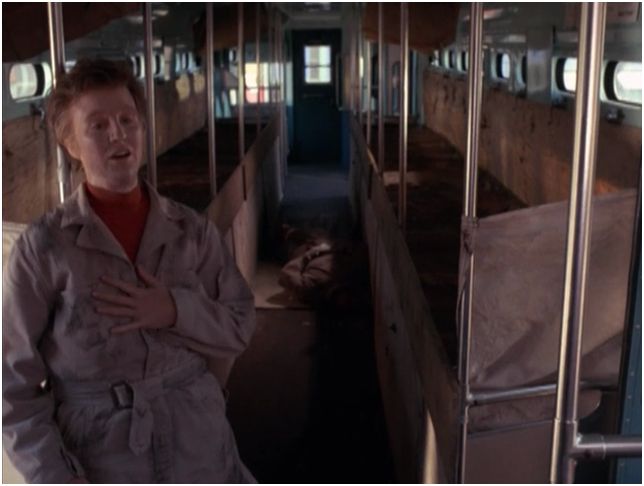
The humor of the film is not derived so much from the characters or their interaction; rather the comedy rides on the silly plot Prinze concocts. Each member of this gang wears funny costumes and those creepy latex masks that were so popular in films made in the 70s, and the women often go in drag as men (very, very ugly men) in an attempt to foil the law. Prinze plays Muff Kovak (!), a small time crook with big dreams and a lot creativity. He enlists some rather foxy ladies to help him out (including Joanna Kerns), but after a series of mishaps, he realizes there is an insider tipping off a thug named Lubeck (James Sloyan) and now the police have also caught wind of the caper. It’s up to Kovak to not just find the squeaky rat, but to also rip off the dough. Sometimes a good man is hard to find, but Kovak is just perfect for this job!
Starring Joanna Kerns as an ugly man!
I liked Million Dollar Rip-Off a lot. It’s different for sure, and it isn’t quite sure what genre it’s going for, but the acting is uniformly great, and Prinze was right, he’s a knockout. It was such a treat to see him shed his usual jovial presence and offer up something a little darker. I thought he did a fantastic job of making the silly crime seem plausible and as the film progressed, I found myself becoming more and more immersed in the story, wondering if they would actually pull off the heist. The end is a bit of letdown, but it was probably the best way for the whole story to play out.
While the beautiful women were certainly a draw, this movie centers on Kovak and his struggles with Lieutenant Ralph Fogherty (Allen Garfield), who is the humorless “good guy” obsessed with catching Kovak red handed. The film was written by the actors William Devane and John Pleshette (the two would later star together on Knot’s Landing!) and according to a New York Times review, these actors had hoped to star in the film. I’m curious as to who would have played Kovak and who would have taken on Fogherty…
Lukin' good Part 2
Million Dollar Rip-Off is far from perfect, but it’s also not just a throwaway TV movie from a bygone era either. It’s the only film Prinze was able to make before he took his own life, and it stands as a symbol of the great potential the actor had. It leaves a bittersweet feeling because I am left wondering what we missed out on now that Prinze is no longer with us, and it’s also great to see that he got to spread his acting wings a little farther, showcasing what a true talent he was.
Everyone can now enjoy Prinze’s lone film because it is streaming on both Netflix and Hulu! Hip hip hooray!
Freddie Prinze was a television staple for anyone who remembers the 70s. A young, vibrant comedian, Prinze stole many hearts as the lovable Chico in the hit sitcom Chico and the Man. By the time he was 19 years old, he was a bona fide superstar, but he burned too brightly and, sadly, burned out by the time he was 22 when he took his own life. Chico and the Man attempted to survive without him, but of course, no one could replace the undeniable charm and instant likability that Prinze held. I don’t remember when I came to know of Prinze’s death, but I think it happened a little after the fact, when the show was in syndication. I was still in my single digit years and I was fairly unaware of the circumstances. I think my parents just mentioned his death in passing while we were watching an episode. I recently picked up his bio, The Freddie Prinze Story which was written by his mother Maria Pruetzel. This biography skips over many of Prinze’s darker qualities and concentrates on his mother’s memory of her beautiful and fun-loving son who couldn’t take the bright lights of Hollywood. Prinze was apparently a tornado of charisma, stealing hearts well before he became a household name.
Pam Grier’s new biography, Foxy: My Life in Three Acts dedicates two short chapters to Prinze, whom she considers to be one of the great loves of her life. She tells a different, slightly darker story and she paints a fuller picture of what Freddie was like when his mother wasn’t around. He was fun and a bit controlling and in the end, Grier walked away from him because of drugs and because she wanted to focus on her career.
I remember watching the TV movie docudrama about his life, Can You Hear the Laughter and I may have actually seen the original airing. But I had not seen his only TV movie, Million Dollar Ripoff, nor had I seen much of his work on Carson or at the Dean Martin Roasts - he was always Chico to me. After reading Prinze’s bio, I felt like his life and work was worth re-discovering and I thought since his birthday would have been on June 22nd, I’d dedicate the week to him. So here we are at Freddie Prinze week, where I will look at Ripoff, Laughter and Chico and the Man. It’s astonishing to think about all the years that have passed since his untimely death in 1977, yet watching him now, he still remains a vivacious presence. I still laugh at his Hungarican jokes and I came across this rare clip taken from The Dinah Shore Show where it looks like Prinze was either the co-host or a guest-host on August 27th, 1976. You will see Cindy Williams and Geraldo Rivera along with Florence Henderson sitting on the couch as Prinze introduces comedian George Miller. The majority of the clip is of the comic, but check out Prinze who bookends it. He lights up the screen. And he will never be forgotten.