Showing posts with label surreal. Show all posts
Tuesday, January 1, 2019
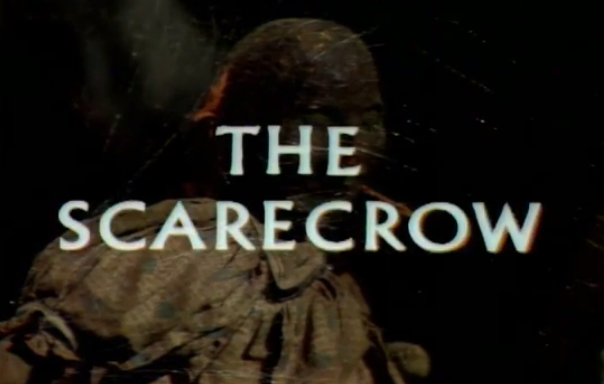
Hollywood Television Theater: The Scarecrow (1972)
Network: PBS
Original Airdate: January 10th, 1972
When Percy MacKaye wrote his play The Scarecrow in 1908, he only meant for his audience to make the loosest connections to its obvious inspiration, Nathaniel Hawthorne’s short story Feathertop. Admittedly, even MacKaye would have a hard time denying the liberal doses he borrowed from Hawthorne’s story about a witch who creates a man out of a scarecrow, sending him off to woo a wealthy, impressionable young woman. But, it is in the metaphor itself that MacKaye drew on something distinct, softening Hawthorne’s condemnation of the class system and of humanity in general.
Hawthorne’s work was often heavily tinged in the surreal, and Feathertop is no exception, mixing supernatural mischief and morality in a way that made the story unique and still oh-so-Hawthorne in the commentary. Feathertop sought to expose people for what they were, and to recognize the irony with which they live their own life, as well as how they choose to judge others (Hawthorne uses the word “trash” to compare the makeup of the scarecrow and that of the human race). Ending the tale with Feathertop returning to its original scarecrow form, Hawthorne surmised that an inanimate object was better off in effigy than had it continued to live as a man. However, MacKaye went down a far more sentimental route, making our scarecrow (named Lord Ravensbane in human form) a sympathetic and sad character whose happiness is only derived when he dies a mortal man. The 1972 Hollywood Television Theater production of The Scarecrow upholds the poignancy of MacKaye’s tale. Although, it also highlights some of the whimsical satire Hawthorne embraced and which MacKaye slyly inserted. It is most noted in a party scene where the upper echelon are eager to welcome Lord Ravensbane’s eccentric character into their wealthy fold, but then are just as quick to disown him, even when the truth of his original form leaves him heartbroken and humiliated.
Hollywood Television Theater was a series that aired on local PBS affiliates throughout the United States from 1970-1978. It was conceived by KCET in Los Angeles and that channel capitalized on its location and accessibility to recognizable faces, casting several high profile actors to appear in their productions. Their debut adaptation of The Anderson Trial starred William Shatner, and Martin Sheen (and was directed by George C. Scott!). Other productions featured Earl Holliman (Montserrat, 1972), Joseph Bottoms (Winesburg, Ohio, 1973) and David Hedison (For the Use of the Hall, 1975). According to Adapting Nathaniel Hawthorne to the Screen: Forging New Worlds, this series sought to give audiences an alternative to the cookie cutter world of television of this era. They brought all kinds of heavy hitting playwrights to the show, including Anton Chekhov (Two By Chekov, 1972) and Arthur Miller (Incident at Vichy, 1973). The directors were often well known journeymen such as Boris Sagal, who directed this entry, but actors, like the aforementioned Scott came into the role too, and prominent performers such as Lee Grant (For the Use of the Hall), and Rip Torn (Two By Chekov) took on the heady productions.
Sagal was a Russian born filmmaker who moved from theatricals to telefilms to episodics on a regular basis. With this production, he keeps things simple, while adding shades of flair along the way. Since it wasn’t shot in front of a live audience, the director threw in a few simple effects that, along with its muted shot-on-video pallor, give the play a substantial measure of filmic surrealism that keeps the viewer a little off-kilter as the play progresses.
At this stage in the history of PBS, the network found itself under fire by certain politicians who thought too much government money went into producing television (sound familiar?). So, PBS sought out a mawkish and mainstream title, and The Scarecrow is now considered one of the lesser adaptations to come out of the series. However, it was also a sorely needed entry, balancing out the edgier fare to appease the mostly upper middle class audience’s more conservative ideologies. It’s a bit ironic that this play sometimes lampoons the types of people most associated the PBS viewership, and also most known for condemning it.
The critics at the time were mixed on their thoughts. Henry Mitchell of the Washington Post wrote, “Nothing in the play is very far developed or very carefully worked out, and the sad result was a shiny-wrapped but none too meaty TV dinner, half-baked.” Conversely, Cecil Smith of the Los Angeles Times quite enjoyed it, calling The Scarecrow a “stunning production” that stepped out of “academic mustiness.” However, Smith also criticized the plush production as maybe a little too expensive for what is intended to be a modest television series, thereby giving greedy politicians a decent arguing point.
Certainly some good money went into the absolutely magnificent cast, which features Blythe Danner, Will Geer, Norman Lloyd, Nina Foch, Elisha Cook, Sian Barbara Allen and an electrifying Gene Wilder as Lord Ravensbane. Wilder’s physical take on manifesting from his original scarecrow state to that of a man, and learning to grow emotionally in that capacity is spellbinding. The scene where he attempts to call out to his mother is both disturbing and sympathetic. And although Ravensbane is definitely the oddest ball in the house, it’s easy to see how the vulnerable and sensitive Rachel (Danner) could fall for his quirky charms.
Pete Duel plays Ravensbane’s nemesis Richard Talbot, the man who has already claimed beautiful Rachel’s hand. Duel is the most under-the-radar actor in the cast, and his delivery feels more tailored for television, as compared to the bigger performances. But it is exhilarating in its own way, anchoring some of the play’s more outlandish moments. There’s also a touch of relatable humanity there. Talbot is jealous but logical and thoughtful, and by the conclusion, empathetic towards his enemy, and ultimately there for him at the end. It’s an interesting yin-yang relationship that could have been explored on a deeper level.
Nevertheless, the end product is both intriguing and delightful. At times a little posh and chaotic perhaps, but also earnestly produced, and extremely well acted. It might lack the morality lesson of a Hawthorne classic, but in an era of unrest and during the Vietnam War, The Scarecrow offers audiences a chance to realize that humanity is a virtue and yes, the scarecrow doesn’t just have a brain, he also has a heart.
This blog post was inspired by an upcoming Australian film journal from Lee Gambin and his film collective CineManiacs. The first issue is dedicated to scarecrows and I wrote about Dark Night of the Scarecrow, and interviewed Jeff Burr about his direct-to-video slasher Night of the Scarecrow. Keep an eye on my social media channels for updates on the release of the journal!
Wednesday, July 23, 2014
USA World Premiere Movie Project: Into the Badlands (1991)
This review has been posted in conjunction with the Daily Grindhouse's year long tribute to the USA World Premiere Movie.
As established in the previous entries of the USA World Premiere Movie Project, the cable network often looked back at the different small screen genre fare of the 1970s, and sometimes produced supernatural tales and thrillers that harkened back to the TV movie’s golden age. One sub-genre that never seemed to get proper attention was the Western, which littered the networks in the early days of the TVM. The rural purge of the early 70s basically eliminated cowboys and prairie tales although they’d raise their browbeaten heads every so often (I’m looking at you Gambler and The Last Days of Frank and Jesse James). It makes sense, in some sort of TV concept way, to consider mixing the high desert with the more popular horror subgenre. I mean, just for giggles.
The year before Badlands was released the home video market tested this hybrid with Grim Prairie Tales, which was an OK movie, but also one that I remember coming in and out of the video store I worked at. I’m sure that’s not the only fusion of the Western and Horror genres, but it was the one that instantly came to mind while watching the atmospheric, but somewhat empty Into the Badlands.
Bruce Dern is essentially Rod Serling, if Serling wore a cowboy hat and spoke with a slight Southern drawl. He is our narrator and also the protagonist of the final story in a trilogy of tales. Dern is T.L. Barston, a bounty hunter who is searching for Red Roundtree (Michael J. Metzger), a “half-breed” that has a $5,000 price on his head. A dream for any bounty hunter in the 1870s for sure, Barston sets off to find Roundtree and collect his fortune so he can leave the barren flatlands for greener pastures.
He first encounters a man named McComas (Dylan McDermott looking super foxy in his Western gear), a man with his own price on his head. He’s on the run and hoping to get to nice little town off of the frontier and near a beach when he meets Blossom the barmaid (Helen Hunt). She’s dying of consumption, but the two fall in love and decide to make a break for freedom together. Of course, you can’t fall in love in one of these kinds of anthologies and expect to get away with it. And I’ll leave it at that.
Barston then shows up at the Huesser’s place, and gives Alma (Muriel Hemingway looking very 1870s) the heebie-jeebies before he heads off into his own story. After he rides off into the sunset, Alma decides to visit an isolated neighbor named Sarah (Lisa Pelikan looking more hauntingly beautiful than ever), just as a storm arrives. Sarah is one of those hoity-toity East Coast people, who like to recite poetry and take themselves too seriously. But she’s also stricken with a fever, perhaps brought on by her lonliness and seething jealousy of Alma, whom she believes is having an affair with her husband. Sarah is sure there are wolves at the door, and it’s up to Alma to protect them both, but from what?
Finally, Barston meets up with Roundtree, and kills him. Arriving in town to have the body identified, he realizes that in exchange for the dead body, Barston may have to give up his own life.
Or something like that…
Into the Badlands makes absolutely no sense. Metaphors only go half way and stories end just when they should be beginning. But dammit, this film has atmosphere for days. Gorgeously shot by Johnny E. Jensen and directed with a strong sense of tension by Sam Pillsbury, I could not take my eyes off this little tele-film, which originally aired on July 24th, 1991. It is exquisitely surreal and manages to captivate despite the lack of a coherent story.
And maybe... just maybe... it’s not the story that’s important, because each tale is threaded together through the theme of isolation, and how it affects the characters. The protagonists are desperately trying to get away from the frontier (screw you, Manifest Destiny!), whether it be to a beach, the city or somewhere else, and these characters are driven mad by their solitude. The setting is authentically barren, both ugly and beautiful, and works as its own character. A dust devil waiting for your soul, if you will. So, despite the fact that I longed for more… more story, more explanation… I could not tear myself away from these Badlands. Recommended. And it's on DVD!
Wednesday, February 26, 2014
Last Bride of Salem (1974)
Network: ABC
Original Air Date: May 8th, 1974
This Toronto lensed shot on video thriller originally aired under the ABC Afternoon Playbreak moniker all the way back in 1974. The Playbreak series, which ran from October 31st, 1973 – February 13th, 1975, was a cycle of 90 minute stand alone episodes that would air once a month, preempting the daytime soap programming, and there were about 4 to 5 episodes per season. The afternoon movie format proved to be popular and many of the Playbreaks won Emmys, including The Last Bride of Salem which garnered an award for TV stalwart Bradford Dillman.
It’s a little sad and strange that Playbreak hasn’t been documented better, it wasn’t until I attempted to research this film that I discovered the series. Luckily, Bride has a bit of cult following and after watching it I can certainly see why. It’s eerie, claustrophobic and well paced. I should also add the score would make any giallo fan's mouth water. There are some decent Goblin-like grooves to be found lurking inside this story of modern witchery!
Bradford Dillman is Matt Clifton, an up and coming artist and doting family man who is offered a chance to stay at a worn-down but large and serene farmhouse so he can create… ahrt! Matt packs up his wife, Jennifer (Lois Nettleton) and daughter Kelly (Joni Bick) and they head out to the serene countryside; only things aren’t quite as tranquil as they had hoped. Jennifer is sure something nefarious is happening to her husband and child, but could it really be an aged old curse taking over their bodies, and preparing Jennifer to become a child bride to Satan? Yikes!
Bride harkens back to the exceptional SOV British series Thriller, which also featured stand alone horror tales. Like Bride, Thriller relied heavily on the less is more tactic of terror. Fairly traditional to the medium during this era, the SOV style really work as far as I’m concerned. Maybe it’s because I’ve been heavily influenced by the look and approach of soaps, but there’s something creepy and effective about straight faced video horror (at least from that period). It works here, because of that particular video polish and because of the strong acting, and just because it’s an eerie story played out just right. In fact, director Tom Donovan and writer Rita Lakin were no strangers to serial world – he directed such shows as Ryan’s Hope and General Hospital and she wrote for the nighttime shows Flamingo Road and Dynasty! Lakin also adapted Death Takes a Holiday into the made for television format and it still remains one of the most haunting and beautiful romance films of that medium. So often this format is considered subpar and certainly the use of video doesn’t help it earn any respect, and that’s a miserable fate for a subgenre so needlessly pushed aside.
And, here’s an oddball piece of trivia: You will spot John Candy as a background character. He appears in a couple of scenes, but the one I remember him in is the ritual scene. I jokingly said, “Hey, it’s John Candy,” and it was!
Wednesday, August 21, 2013
Those Secrets (1992)
Network: ABC
Original Air Date: March 16th, 1992
OK, maybe I’ve been taking too many critical theory classes, but I think the bizarre and fascinating TVM Those Secrets may be the first post-structuralist small screen film I’ve seen. Or, maybe I was just more attune to it since I’m knee deep in cultural theory as I write my final senior paper. Or, maybe I don't understand it at all but think I do (school does that sometimes too!). At any rate, damn. Those Secrets does a fantastic job of decentering the audience with narrative slippage. The result was that the film is, at points, both an alluring failure and a disturbed success.
![]() |
| Alluring failure or disturbed success? I'm not sure yet |
“Neille Banesh (Blair Brown) put her call-girl days behind her to become a wife and mom, but boredom with her humdrum life -- coupled with the revelation that her husband, Simon (Arliss Howard), is cheating on her -- sends the incensed homemaker back on the path of prostitution. In this story of self-discovery, the escort reconnects with Leonard (Paul Guilfoyle) and other clients in between sessions with her therapist (Mary Anne McGarry).”
OK, OK, the first half of that summary is accurate, but the second half simply does not account for all the weirdness that unfolds as Neille is hurled through a whirlwind of despair. Granted, it’s a slow moving whirlwind, but you get my point.
![]() |
| Call girl digs |
![]() |
| Kind of digging this look. I mean, aside from the strange guy's hand around her neck |
![]() |
| Retirement home gone wild! |
![]() |
| Yikes |
“It's an unsettling film, daring in its kinkiness and in its scattered but sophisticated visual and narrative style. Brown and Howard distinguish themselves and are buoyed by a cast that includes Paul Guilfoyle, Louis Gimbalvo and Mare Winningham.”
![]() |
| I'm guessing she has a secret |
![]() |
| Fairly accurate representation of how I felt after watching Those Secrets |
Tuesday, July 30, 2013
TV Spot Tuesday: SOAP!
When SOAP premiered on ABC on September 13th, 1977, I was not allowed to watch it. I remember it came on fairly late at night (9:30 on Tuesdays), and I must have been getting ready for bed at that time. Still, to this day I have no idea if I wasn't allowed to watch it because of its time slot or because of its content. A few years later, when SOAP went into syndication, our local channel showed it nightly at around 7 pm or so. I was older and wiser, being all of nine or ten at the time, so I guess my parents thought it might be alright to let this kid give this incredibly smart series a go.
![]() |
| I have no idea what Bert is talking about, but I bet it's funny! |
![]() |
| Jimmy Baio = adorbs |
![]() |
| More tissues, please |
Did you know there is an upcoming book about SOAP? Visit Soap! The Sitcom That Broke all the Rules for the deets.
Peter's Murder (aka an good excuse to look at Robert Urich):
Tuesday, June 4, 2013
TV Spot Tuesday! Night Cries (1978)
Network: ABC
Original Air Date: January 29th, 1978Susan St. James plays Jeannie Haskins, a grade school teacher who loses her baby almost immediately after it’s born. She attempts to return to her everyday life, but is haunted by nightmares of a house, a child and a crying baby. Her husband, Mitch (Michael Parks) sends her to a dream psychoanalyst named Dr. Whelan (William Conrad), and he interprets her imaginings as a message from the past. However, Jeannie insists that the crying in her visions is coming from her baby who is calling for help (how creepy is that?). Eventually she comes to find that her dreams carry two very separate but equally disturbing messages.
![]() |
| Yikes! |
![]() |
| This is pretty much how I looked in Brian Taggert's awesome class |
![]() |
| Calling Dr. Phallic, uh, I mean Freud! |
![]() |
| Bad dreams... |


Tuesday, February 26, 2013
TV Spot Tuesday: The Devil's Daughter

I think it would be safe to say that Shelly Winters was a versatile actress. When she was good, she was good, but when she was bad... well, stand back! Winters made a few forays onto the small screen during the heyday of the Movie of the Week. It was here that she got to be at her most nefarious and she did it with such aplomb, it was almost impossible to take your eyes off the screen.

Such is the case with her 1973 TV Movie, The Devil's Daughter, which aired as an ABC Movie of the Week on January 9th, 1973. Shelly is Lilith, a wealthy woman with a mute "companion" (Jonathan Frid in a great performance) who takes in Diane (Belinda Montgomery) after her mother dies (Diane Ladd). The place is quite homey at first, well, except for that picture of Satan hanging over the mantle! Things are almost kind of Stepford-ian and definitely surreal - check out the twin sisters, one of whom is white and the other black! With some encouragement from her local pastor, Diane moves in with a girl her own age, but that won't stop Lilith from leading Diane to her birthright... as Satan's Daughter.
The Devil's Daughter came riding on the heels of such horror films as Rosemary's Baby and The Brotherhood of Satan. Obviously, this minion of Satan could never rival its silver screen counterparts, but pay no mind to that, this is a fun, suspenseful movie that carries a creepy vibe throughout. Belinda Montgomery, one of the prettiest actresses of the 70s, is in fine form here and plays the part fairly quietly, but with an air of strength about her. She finally comes out of her shell when she becomes annoyed by Shelly and she gives the nasty right back!

Full of colorful characters, the Poole sisters are probably my favorite, although it's hard to deny Abe Vigoda with a slight British accent! Frid is equally as sublime in a touching and underrated performance. Oh shoot, I love them all! The entire group truly takes on their roles as cult followers with pleasure.
Stylishly directed by Jeannot Szwarc (Jaws 2) and written by cult favorite Colin Higgins (Harold and Maude of all things!), there's nary a moment that isn't entertainment at its best. Well, its TV Movie best, and really can that be beat?

Check out this incredible promo for The Devil's Daughter when it aired as a Tuesday Movie of the Week:
Friday, May 25, 2012
Biddi, Biddi, Biddi: Oh, Buck!
When I think of Buck Rogers I think of those warm summer days and nights of my childhood, where Twiki was a hot topic and Princess Ardala was one scary Draconian Princess! Although it only ran two seasons, Buck and his merry day-glo band left a deep impact in my heart. As an adult I see why, although I'm sure I didn't catch a lot of the suggestive humor or camera trickery. Nor did I truly appreciate the awesomely awesome costumes which adorned such lucky actresses as Erin Gray and Pamela Hensley (btw, did they sew Erin Gray into that super tight blue thing she always wore? Holy cow). But now that I'm revisiting the series via Netflix I am reassessing all things late 70s spacey.
The episode Escape From Wedded Bliss isn't necessarily better than any of the other episodes, but it left me gobsmacked by the colorful cornucopia of glittery royal bikini wear (really Princess Ardala, that's just a bathing suit with a sparkly hat and cape) and the bright, bright lights of New Chicago. If you remember Buck and think you might not find the show as much fun in your adult years, I think you should go to Netflix now and get your Dr. Theo-on because it's even better now. Or maybe I'm just remembering it better now... who knows? At any rate, I encourage one and all to re-fall in love with all things Buck!
The highlight of the episode was that they actually featured a scene with Twiki acting! I'm not kidding. He's all upset that Buck won't take him on an adventure so he starts to mope (in the dark no less). Buck finally feels the guilt and invites Twiki along for the ride. Here are two of the more moving moments from the episode:
Labels:
current obsession,
glamour,
illicit going ons,
kids classic,
links,
must see streaming tv,
randomness,
romance,
sci-fi,
sexual frustration,
sexy,
stud,
surreal,
tv series,
white hot
Subscribe to:
Posts (Atom)


