To promote the airing of Sharing Richard, the network released a brief statement declaring the film "explores a timely phenomenon: the shortage of single men for women over thirty." To present the issue, Sharing Richard was designed as a "contemporary comedy," in what may have been a sometimes misguided effort to dissect a topic that was on a lot of minds.
Then, shortly after Sharing Richard originally aired, an angry viewer wrote to the Los Angeles Times, complaining, "The concerns of singles dating are very real and complicated issues. The movie's plot utterly made fools of these four characters whose self-awareness, self esteem and mutual respect seemed to be in the dirt. Women were in their usual role of apologizing for messing things up and the man could somehow spread his "caring" among many women. The movie pretended to have a modern plot but frankly it was a long way from giving any kind of decent message about modern relationships."
This may be an issue...
The TVMs of the eighties often had a weird relationship with the women in them. Recently, I was just considering how the telefilm, as a medium, has proven to be a rather female-centric space, featuring so many actresses that are often aligned with the genre, such as Barbara Eden, Patty Duke and Donna Mills (in fact, you can hear my co-hosts and myself discuss the topic on this blog's companion podcast). Yet, even with all of those strong women (and I'm talking outside of the Aqua Net and shoulder pads), there was a real tug of war between making female characters independent while having them chase down a hot guy with a good job. The sentimental, Harlequin-esque romance (which I am totally into) sometimes overwhelmed the idea of female independence. This, my friends, is a bit of an issue (although in the context of entertaining fluff like Sharing Richard, a sometimes fun and mostly inoffensive one). It created an uneasy mixture, and it was up to the Eighties Woman (well, really it's up to the actress playing her) to make the whole thing flow and not seem like it was a conundrum at all. Did all of this back and forth confuse my growing brain? Probably, but that's OK. As nostalgic and sappy as I can be, I don't discount that films are time capsules - especially TV movies - that tended to fall on the most prominent contemporary beats to quickly engage the audience - and are sometimes best served by viewing them with a grain of salt.
In short, unlike the lady who wrote to the LA Times, I make excuses for my romance. So sue me.
Men might be scarce, but there were plenty of 80s sweaters to go around!
Sharing Richard, which is ultimately delightful and flawed, walks this fine line in an attempt to bring all of those modern ideas about love and sex into a story about three best friends who exude independence, but are essentially really, really, really about finding Mr. Right. I won't call them desperate because despite their desire for love and marriage, they also come across as contented with their life as is. Of course, all that goes to hell when they realize they are all falling for the same guy!
The women:
The man:
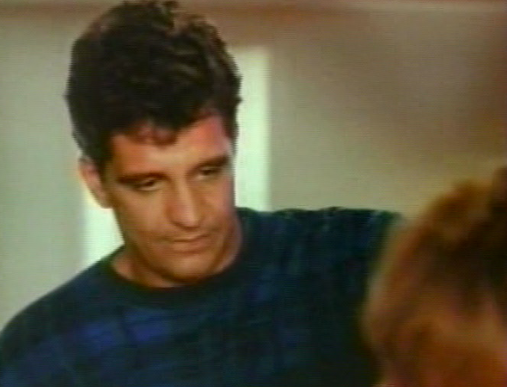
Admittedly, that guy is pretty much everything. And when I say everything you know I'm not overstating this because it's Ed Marinaro. Eighties Ed Marinaro, a few years after Police Woman Centerfold (lord help me, I love that movie), and Laverne and Shirley (btw, is it just me, or is it creepy that Ed played Laverne's cousin and then went on to play her boyfriend... yikes!) . Anyway, Richard is a handsome and charming plastic surgeon who just happens to be recently divorced. While somewhat bitter about his marriage breaking up he turns out to be a great date, fulfilling certain individual needs in each woman. So, why not just pass him around like a great sweater (an analogy a character uses)? And they do.
At first it's fairly innocent, but then this thing called love gets involved and the trio of lifelong BFFs find themselves sneaking around each others' backs and growing more and more jealous of whichever friend has Richard on any particular night.
Despite the oogie factor that creeps in when two of the friends start having sex with Richard, the film does its best to keep the women likable, and even to a certain degree, Richard, who probably should have been more honest about his dating schedule, but who is also unaware that these women are friends.
Potential mic drop moment...
Of course, marriage and family were, and remain an important core goal for many, female and male. Still, the women in the TV movies of this era are often obsessed with finding the perfect husband, and having babies (see Babies for a more than obvious example). All of this would happen with characters who were also portrayed as independent and career driven. Certainly, you can have both (and hats off to those who do), but inevitably Sharing Richard is a reflection of the eighties (by way of the fifties) American Dream, which includes the white picket fence and 2.5 kids, but with a dose of second wave feminism that mirrored the career woman who "wanted it all." And, the result is that characters can come across as more pathetic than focused or ambitious.
Well, currently 1/3 of him is focused
Luckily, this telefilm goes for the light touch, and has genuinely funny moments, using humor to examine the issues.
The trio of leading ladies are amazing, and I was especially pleased to see Hilary Smith, best known to me as Nora from One Life to Live, showing off her adept comic timing. Her character is a bit grating, but the one liners are choice, and her delivery perfect. Eileen Davidson is great as well, and looks amazing (and pretty much the same as she does now). I was not as familiar with Nancy Frangione, and while I feel her character is the weakest of the bunch, the actress does a good job of making her likable.
Buds before duds...
When these characters become hostile towards each other over a man, it is apparent that the message is mixed and muddled. But some of the humor is timeless, the actresses are warm and Ed... well, he's hot. Despite its flaws, Sharing Richard is worth a watch, mostly for the actors... and shoulder pads, but its also just so damn amiable and more charming than it has any right to be.
Network: ABC Original Air Date: December 19th, 1993
I remember tuning into The Only Way Out when it originally aired in the early 90s. There was noway I was going to pass up a chance to catch John Ritter and Henry Winkler – two of the funniest and nicest men in showbiz – going toe to toe in a surprisingly gripping domestic thriller. The Fonz vs. Jack Tripper?!? That’s front row seat material! I know… I probably needed to get out more. But work with me here, because The Only Way Out is intriguing and suspenseful, and if nothing else, it’s worth catching for Winkler’s excellent portrayal of a manipulative abuser.
Ritter is Jeremy Carlisle, a nice guy who wants his recent divorce to be as amicable as possible. While the three kids he had with his ex-wife, Lynn (Stephanie Faracy) are mixed on the separation and the couple are obviously lugging around some extra carry on baggage, for the most part things could be much worse. And, the words “much worse” come in the form of a guy named Tony (Henry Winkler), a man who is all goofy on the outside, but a seething cauldron of hot water that is just about to boil over on the inside. His escalation from verbal abuse to violence is quick and terrifying (his groveling regret is just as disturbed), and Lynn isn’t quite sure how to react, so she turns to Jeremy for help. This only serves to aggravate both Jeremy and his new wife Susannah (Julianne Phillips), and it also drags Jeremy into an ugly confrontation where only one will come out alive!
Ritter and Winkler had been searching for a project to do together when the script for The Only Way Out fell into their hands. Originally, the pair was gearing up to work on a comedic TVM titled The Sob Sisters, but the film was scrapped due to script issues. Then they were approached to star in The Boys (a TVM about Columbo's co-creators, Richard Levinson and William Link), but the parts eventually went to John Lithgow and James Woods. Around this time, Ritter had become interested in a British thriller titled One Way Out and his production company, Adam Productions, picked up the adaptation rights. Although Ritter was working on the remake he was surprised that it turned out to be the film that would finally team up the talented comedians. Ritter said, “We didn’t realize that such a heavy, dark piece would give us our first chance to work together, but we’ve wanted to do it for years.” So be it, right?
After production, ABC tossed around airdates and the tele-film was originally scheduled to air in November, during sweeps. Ritter believes the creepy thriller was pushed back because some executives were nervous about the heady subject matter and violence. Strangely enough, the network decided to air the TVM during the Christmas season! There's just a touch of irony in there.
In many ways this top-notch small screen suspenser mimics much of the same frustration of the 1990 theatrical film Pacific Heights, by creating a character that exasperates the bejeezus out of you. Dammit, I wanted to kill off Winkler’s character too. Ritter is maddening as well, because Jeremy cowers more than protects. And yet, I can’t imagine how I’d react to a madman showing up at my house, my work, and every other nook of my life. Critics had mixed opinions on The Only Way Out, but many were fascinated, and ultimately taken in by John Ritter and Henry Winkler’s dramatic turns. Ritter stated that both he and Winkler auditioned for the part of the baddie, but now that I’ve seen the movie (a couple of times), I can’t imagine what it would look like if the roles were reversed because the casting is oh-so-perfect. And, that makes it all the more unfortunate that this engaging thriller has fallen by the wayside.
Like the character Jim Bronson, Then Came Bronson's creator, Denne Bart Petitclerc was a newspaperman, and someone who enjoyed observing people. And also like the enigmatic Bronson, Petitclerc was a bit of nomad (although he had a full family in tow), and dropped journalism to work in film. Bronson became Petitclerc’s way of expressing how youthful late 60s America was in a desperate search for itself, and for many the character spoke to young people in ways no other series had (one commenter on IMDb said that the show symbolized what it was like to be free).
NBC, along with the other two networks, were quickly becoming aware of a new demographic. The audience to attract came between the ages of 10 – 31, and the networks were trying out a variety of shows, including The Mod Squad and The New People in the hopes they could create hip programming that spoke to a generation in the middle of a war, the hippie movement and other late 60s issues that were particularly youth orientated.
And, not only was this type of with-it prime time scheduling something new, the TV movie pilot was also a fairly novel phenomena (1966’s Fame is the Name of the Game was the first pilot TVM, spawning The Name of the Game in 1968) and, indeed, tele-films in general were still a fairly revolutionary device. Bronson, which originally aired on March 24th, 1969, was unique in other ways too - it was quiet and almost plot-less, featuring a handsome Michael Parks as Bronson, a man ripped apart by his friend's suicide (Martin Sheen in an early role). Bronson realizes that living in a 9-to-5-monkey-suit-world is not for him, and he hits the road with the mysterious young woman who refuses to give her name (Bonnie Bedelia in an intriguing early role). Starting in San Francisco, there are lots of overhead shots of winding roads and roaring oceans. The couple was at home sleeping in the wild and although Bronson had a general destination (New Orleans), the trip seemed to be about getting lost in nowhere and enjoying the ride. At points the TVM even takes on a documentary vibe.
Then Came Bronson was hard to categorize in a pithy synopsis, but critics and audiences loved it, as it marked a departure from the regular programming. To give it a bite-sized promotion, some called it Route 66 for a new generation. Parks, who was already a well-established character actor, also provided some music for the series as well (he was a recording artist, and also did a bit of singing in the 1977 TVM Escape from Bogen County).
Because the pilot TVM was so well received, NBC dug deep into their pockets with high hopes for the series. They ran an encore performance of the pilot on August 2nd, to remind audiences what they fell in love with earlier that year. Producer Robert Justman (who had previously worked on the more overtly symbol-ridden Star Trek) said that despite the gorgeous camera work, the goal of the series did not have much to do with technical prowess, and commented that it didn’t matter if the sound was off or something didn’t work out. Bronson was about life, and that’s what they were trying to capture. Unfortunately, Bronson could not sustain its audience and was cancelled after one season. Ironically, part of the problem was that the audience they wanted to attract were actually living outdoors, some much like Bronson, and not watching much television. It was considered a disaster for NBC because of the expense of the gorgeous cinematography and on-location shoots.
But many still recall the series fondly, and the pilot movie has aged amazingly well (I have yet to see the series). It's definitely worth a watch or re-watch.
Perhaps it was somewhat meant to be when I ran across the above scan I took for the short-lived series All That Glitters. I remember scanning it because I thought it was for a mini-series. Seriously, does that not sound like a great title for a shoulder padded drama? Indeed. However, I saw that it was a comedy produced by Normal Lear that featured the incomparable Eileen Brennan, among many other great talents. Sadly, Miss Brennan passed away last week at the age of 80. How I adored her smoky voice and red locks. She was stunningly unique, and a great talent. So, although I've never seen All That Glitters, I thought it might be nice to spotlight it on TV Spot Tuesday.
Newspaper promo for All That Glitters
As previously mentioned, the series was created by Norman Lear and it aired in syndication. In some ways it was much like Lear's other satire, Mary Hartman, Mary Hartman in respects to the approach to humor and because it ran nightly. It garnered a lot of controversy when it was released because the premise regarded women in positions of power in the corporate world while men were the subservient party, working as secretaries, etc. The company was called Globotron Corporation and was run by L.W. Carruthers (Barbara Baxley), and apparently she was a bit of a man eater (if you know what I mean).
The ridiculously awesome Lois Nettleton!
Linda Gray took on the controversial role as a transsexual. In an interview she noted that playing that character was instrumental in securing her role as Sue Ellen on Dallas! Gary Sandy played the secretary with "the cutest little buns in the corporation" (thank you for that tidbit, Total Television)! All I could find about Brennan is that she played an important recurring character who was named Ma Packer.
The series, which lasted for 65 episodes between April and July of 1977, is probably best remembered for spawning the song You Don't Bring Me Flowers, which was originally intended to be the theme song for the series. The tune was written by Neil Diamond with Alan and Marilyn Bergman. When Lear decided the song wasn't right for the show, Diamond expanded it and you can listen to him sing it with Barbara Streisand below.
Holy cow, so much interesting history in a series that seems to have all but disappeared! I'm curious if any of you remember this groundbreaking comedy? And what can you tell my about Brennan and Gray's roles?
Here is a promo for All That Glitters
Here is a clip of Neil Diamond and Babs belting out You Don't Bring Me Flowers
When SOAP premiered on ABC on September 13th, 1977, I was not allowed to watch it. I remember it came on fairly late at night (9:30 on Tuesdays), and I must have been getting ready for bed at that time. Still, to this day I have no idea if I wasn't allowed to watch it because of its time slot or because of its content. A few years later, when SOAP went into syndication, our local channel showed it nightly at around 7 pm or so. I was older and wiser, being all of nine or ten at the time, so I guess my parents thought it might be alright to let this kid give this incredibly smart series a go.
I have no idea what Bert is talking about, but I bet it's funny!
As a kid, I loved it mostly because Burt Campbell (Richard Mulligan) was insane and adorable. From believing he could make himself invisible, to alien abductions to becoming sheriff (!) of Dunn's River, Connecticut, it was virtually impossible for me not to grin when he was on screen. However, while Burt may have been the original draw for my young-person-brain, I was also getting into some rather heady stuff. Alongside all the infidelity, prison breakouts and baby possession, SOAP worked mostly because it understood the connection melodrama has to raw human emotion. Jody Campbell's (Billy Crystal) struggle to become not just a father, but recognized, respected and accepted as a gay man who is a father, wasn't without its bumps in the road, but was told with a lot of heart and introduced issues that many of us had probably never considered. There was also Danny's (Ted Wass) awakening to racial intolerance when he dated Polly (Lynne Moody), and the ongoing hilarious, but also heartbreaking tale of Chester and Jessica's I-love-you-I-hate-you-saga. Oh, and then there's the episode where Benson leaves. Tissues please.
Jimmy Baio = adorbs
But nothing was as tragic and as haunting for me as the death of Elaine (Dinah Manoff). In her agonizingly shocking and sad final scene, she dies in Danny's arms not long after he realized that he really did love her. To this day, I still get choked up when I think about it.
More tissues, please
And that was the beauty of SOAP, which ran for four glorious seasons. They understood how to walk the fine line of outrageous stories told with simple but very real feelings. I know most people think of SOAP as a spoof of the daytime drama, but it was really an all out glorious tribute, all done with a big smile and bunch of hearty laughs. That's good television, indeed.
I wasn’t joking when I said that soap operas were just like their characters – they never truly die. And it looks like All My Children and One Life to Live will be resurrected yet again when they return to television for a limited engagement on Oprah’s OWN cable channel! Beginning July 15th, OWN will air the first 40 episodes of the revived serials.
I think many soap fans remember how we turned to Oprah when the shows were cancelled and she said financing them was not a feasible option. Well, times and hearts change and it would appear that picking up the shows rather than producing them makes it a much more viable option for OWN. While I was not particularly pleased with Oprah’s original rejection, I have to say this seems like a really smart win-win for both OWN and the shows’ production company Prospect Park. The largest obstacle going against the new shows is that some fans have been extremely resistant when it comes to changing their viewing habits from television to the internet. I hope this draws them in and if they are successful, it is possible some will move over to Hulu or that OWN will continue to air the shows.
Oh yeah, and if you can't wait for next week, you can stream all the episodes for AMC here and OLTL here. Presto.
All My Children will air Monday-Thursday at 1 PM. and One Life to Live will air Monday-Thursday at 3 PM.
Yes sir, it looks like love has returned to the afternoon, so I thought it might be fun to post some promos from the 80s. I do hope everyone tunes in to this 10 week run. We are proving to be a force, and while this may seem low on some people’s importance scale, it is imperative to note that when you organize yourself and others around something your are passionate about, you really can make a difference. And that's my pep talk for the day!
So what are you waiting for? Let’s get our soap-promo-groove-on!
Here are some great promos for AMC:
And here are some more for OLTL:
And here is a double whammy twofer combo batch of awesomeness:
I shouldn’t be too ashamed to admit that I’ve never seen Toma. According to Wikipedia, the short-lived series never ran in syndication. For years, I’ve heard of the infamous show but had no idea it was based on a Newark, NJ cop named David Toma. The real life Toma was some kind of badass! The veteran cop gained fame because he often wore disguises so he could infiltrate various criminal rings and, after thousands of arrests, he enjoyed a 98% conviction rate. Toma and his outlandish cop-style became so famous that ABC decided to create a series based on his larger than life persona, and the ruggedly handsome Tony Musante was cast as the reel-life police officer.
Mr. Toma was proud of the 90 minute pilot movie. He said in an interview, “It’s not the story of a cop. It’s the story of a human being who happens to be a cop. It shows why I’m different.” No shrinking violet, Toma added, “You must have an ego to do what I’ve done and you must believe in yourself. Everybody I work with realizes, ‘why fight him, join him.’ I’m news and everybody wants me… I’ve worked hard and I like the flamboyant life.” Although Toma did work briefly as an actor in the 70s, including landing a small part in the Columbo episode Lovely but Lethal, he said he was committed to working as a police officer, and stated, “It’s in my blood.” Toma is now a public speaker helping people with addiction issues. You can read more about him at his website. And yes, I now totally love him.
Courtesy of Vintage Toledo TV: This has to be one of the strangest lineups ever.
Despite ABC’s desire to renew Toma for a second season, Musante walked away. It was rumored that he only wanted to do one season so he could continue to pursue other acting endeavors, but in an interview Musante attempted to clear up the rumors regarding his willingness to play America's favorite master-of-disguise-copper. Mustante said, “Before I made the pilot, we all agreed that if the pilot was successful, and ABC picked it up, I would do a full series – a weekly hour show for only one year. If ABC wanted to continue, I would do it as a mini—series. I have a contract that says just that. Maybe they figured I didn’t mean what I said.” Apparently, Musante was offered a nice amount of money to return, but still decided to decline. Musante reasoned, “Doing a series is a seven-days-a-week thing, especially when you’re the leading actor. You’re on the set five days, in the studio watching rushes on Saturday, and holding discussions with the writers on Sundays. I want to work in television, but I also want time to do films and theater.” Indeed, Musante has worked steadily on both television and Broadway.
After Musante left, ABC pulled off its greatest undercover assignment by changing Tony Musante into Robert Blake and renaming the series Baretta. The show, which was a midseason replacement, lasted 3 ½ seasons.
It never occurred to me that Louise Lasser and Charles Grodin might be two great tastes that taste great together, but then I stumbled across the promo for the NBC tele-film Just Me and You. This quirky comedy which originally aired on May 22nd, 1978 appears to be a bit of a Planes, Trains and Automobiles precursor. According to Arvin H. Marill's Movies Made for Television, the film is a "comedy-drama about a slightly daffy New Yorker with a compulsion to talk who shares a cross-country drive with a down-to-earth salesman."
I will admit that I have not dipped my toes too deeply into the world of Mary Hartman, Mary Hartman, but I've been a big fan of Lasser ever since I caught Isn't it Shocking (aka one of my favorite made for TV movies of all time) years ago. Her career has been one that has always intrigued me. Aside from Shocking and Mary Hartman, Louise has appeared in everything from the splat-tastic horror film Blood Rage (aka Nightmare at Shadow Woods) to the camp classic Frankenhooker to the quirky and disturbed Todd Solondz tragicomedy Happiness. She has always charmed me with her offbeat beauty and great comedic timing. And well, Grodin is just adorable. But I wonder, is it bad that the thing I remember him best for is his cameo as himself on Laverne and Shirley? Hey, that's how I roll.
I was doubly pleased when I discovered that Lasser also wrote the screenplay for Just Me and You. She said it was a way to work out some personal angst. In an interview Lasser remarked, "I'd like to feel, uh... less anxious,,, all the time about what I'm gonna do this day or this night or this holiday or this Sunday. I don't want to worry about that."
She began her script while Mary Hartman was in production, and resumed writing after going into seclusion when the series was cancelled. She decided that Just Me and You should be her next project despite the fact that her original script was nothing more than 300 pages of conversation. The writing was cathartic for Louise who noted that the character Jane started off very flighty, but as the actress calmed down, the character also took a chill pill (Lousie played Jane in the movie as well). She gave the original script to an executive producer at NBC named Deanne Barkley, and she encourage Louise to work on it. Critics found that final product to be "warm," "enchanting," and most importantly, "funny."
Just Me and You was the 1st of what was to be a three picture deal with NBC. However, this remains the only produced script that is solely Louise's (in 1966 she co-wrote What's Up, Tiger Lily). That seems really sad to me. This film was obviously a labor of love, and I would have liked to have seen more scripts by this charming and lovable actress. Just Me and You did enjoy a VHS release.
Update (3/15/2014) The promo was removed but I found this clip for Just Me and You:
I am surprised and somewhat shocked that I had no idea that Suzanne Pleshette and Gil Gerard made two TV movies together – and then appeared yet again in the short lived series Nightingales! Where have I been?
I have loved Help Wanted: Male since I first laid eyes on it. Aside from Pleshette and Gerard, Harold Gould and Bert Convy also appear in this adorable comedy about a sharp and successful businesswoman who wants to have a child. Airing on CBS on January 16th, 1982, Help Wanted seeks to speak to that blurred lined of the then forming feminist ideology, where some women weren’t sure if having a career meant giving up a family. Pleshette is beyond sophisticated but is also caught up in the same dilemma that many women tackled during the era. Of course, choosing between Gerard and Convy is a nice perk, and this romantic comedy tends to speak more to the heart and only slightly to feminism. Take that as you will.
Help Wanted was a booming success, garnering 47.7 in the ratings for the evening, and coming in at the number 3 in the Nielsen ratings for the week!
Here is the promo for Help Wanted: Male:
For Love or Money was another CBS TV movie that paired Gerard and Pleshette together. It originally aired on November 20th, 1984, and I have not seen it, but it looks like a lot of fun. The premise revolves around a television producer (Mary Kay Place) who comes up with an idea for a game show: Find two extremely compatible people (Pleshette and Gerard) and offer them the choice of marriage or a huge amount of money.
This seems to be both a spoof of game shows and a parody of modern romance. Based on the chemistry exuded from Ms. Pleshette and Gerard in Help Wanted, I think we can assume that their touch of gold most likely applies to For Love or Money as well. Although it doesn’t seem to have garnered the same positive reviews of Help Wanted, anything with Jamie Farr as a sleazy game show host must be worth seeing!
Here is the promo for For Love or Money:
And finally, Gerard and Pleshette teamed up yet again for the series Nightingales! Nightingales also featured Barry Newman who appeared with Pleshette in one of my all time favorite TV movies, Fantasies (you can read my reviews here and here). I’m not sure where Gerard fits into the series, but I think he would make for a nice triangle with Newman and Pleshette!
Again, I have yet to see this show, but as a bonus here is the opening credit sequence below.
I have also written about some Nightingales trivia, which you can read here!
Here is a newspaper promo for Fantasies that doesn't necessarily apply to this post but I wanted to post it, so there!