Showing posts with label must see streaming tv. Show all posts

Sunday, April 21, 2019

Must See Streaming TV Project: Insight (1960-1985)

 
If you follow any of my social media, you've probably seen my recent posts on TV movies streaming on Amazon Prime. I have found a gazillion amazing TVMs and the feedback on my posts has been quite positive, so I'm extending this project to cover an intriguing syndicated religious television series called Insight.

I've been interested in Insight for some time now, and actually did a bit of research on it many years ago, in the hopes I could write something about it. Unfortunately, that research and time have slipped away from me. But recently, I noticed that episodes began appearing on YouTube, in what looks like legal channels.


*Just a note: I realize there is an amazing amount of content online, available through many different means, but I only want to promote product I think is being streamed by the proper rights holders. It might stem from working at the Directors Guild for so many years that I've been trained to do this, but I think it's important we support the people who may be in charge of getting these things out into a physical format, properly cleaned up and with extras, if possible. I certainly don't discourage anyone from watching what they can where they can (your passion for classic TV and telefilms is why I'm here), but I will only promote the legal streams.

That said, OMG, guys! Insight is online and looking great. The YouTube page looks to be run by Paulist Productions and it just appeared recently and is constantly uploading new episodes! So, I've decided to pick an episode, probably on a bimonthly basis, and do a short capsule review with an image or two. Hopefully I can dig up enough trivia as a way to provide a little production history to this fascinating and long running series.

I'll be adding every review to this post, and my picks will be random, but I'll list them in alphabetical order. Hopefully I can put together a decent catalog, with access to every episode Paulist Productions uploads. Call me a classic TV freak, but honestly it's exciting.


So, as I said, my previous research kind of went by the wayside, so let me tell you what little I remember about the show. Insight was created by a priest named Ellwood E. "Bud" Kieser. It's my understanding that he was interested in non-denominational preaching, and this series ran the gamut of episodes that felt either like The Twilight Zone or an ABC Afterschool Special. They could be really surreal, or sometimes they were based in the very real. It could be faith-based, but often it was driven by social issues. And the class of actors was astounding. I think Martin Sheen is in a huge amount of episodes, but you'll also see Bob Newhart, Jack Klugman James Farentino, Bill Bixby, Patty Duke and Cicely Tyson, among many others.

I'll be researching the series as I go along, and I hope I can dig up some interesting nuggets for everyone. This is a work in progress, and I'm unsure of the exact layout (i.e. will trivia go with an episode or get its own section, etc.), but I think it will be fun.

You can always check back here, but you can also find updates at the following:

Facebook
Twitter
Instagram


*One final note: It probably means nothing, but just to clarify, I'm not particularly religious, although I love faith based television. (Confession: I was a die hard Touched by an Angel fan!) I think these kinds of shows are really fascinating, especially when they are more driven by social issues. This is all to say, I won't do any proselytizing here. I only want to look back at the historical and cultural impact of the series. Whatever your belief system, I hope you come along for the ride!  

So let's get started!


All the Little Plumes in Pain (OAD: September 17th, 1967, episode #193, reviewed June 21, 2020): A young but square attorney finds himself in the middle of the counterculture movement when he attempts to lure his friend Jenny (Celia Kaye) out of Haight-Ashbury. Her friends don't want to let her go, but what looks like a clash of cultures soon becomes an understanding of love, friendship and family as the straight-laced lawyer finds he may have underestimated Jenny's hippie circle.

Original newspaper listing
All the Little Plumes of Pain is surprising in how it takes an affectionate view of the hippie movement. While there is talk of drug use (and talk against it), overall the counterculture characters are portrayed as offbeat but good. The lawyer, played by Guy Stockwell (looking so young and dapper!) is also a good person whose main concern is to simply facilitate a young woman's reunion with her parents. However, his tactics are more obvious, and somewhat corrupt. Jenny is underage so he threatens to shut down the printing press she helps to run, which would lead to an eviction of everyone else who lives in that humble space they've carved out for themselves. He also attempts to bribe the group. He is taken aback when he sees them holding a small service dedicated to God, and shocked when they return his threats with love. In the end, the little plumes in pain are Stockwell and others like him, caught up in the monkey-suit-nine-to-five existence that leaves them condemning and community and friendships that seem different from the norm.


Directed by one of my favorite small screen filmmakers, John Newland (Don't Be Afraid of the Dark), this would be the first time Newland worked with Kaye. She also appears in a Young Lawyers episode he directed, and she is featured in Newland's aforementioned small screen monster classic Don't Be Afraid of the Dark. She's quite lovely and puts in a measured performance as the lonely little girl just looking for purpose and love. However, while Jenny is the central character, this episode belongs to Stockwell and Prine who quietly battle over the young woman. Jenny makes the decision that is right for her needs, but both choices offer hope for her future. The ending shot of one of the hippies playing hopscotch (something they do throughout the episode) is given some depth when Prine explains, "Hopsotch is just a game. A game you play trying to get around the squares." It leaves a sort of eerie open-endedness to the episode I wasn't expecting. Newland does it again!

 
Checkmate (OAD: November 13th, 1979, episode #421, reviewed May 12th, 2019): Checkmate is a quirky entry into Insight. It's about a guy named Andy (Bruce Davison) looking for the perfect mate (as it were). And, with an emphasis on the word "perfect." So, it might not be a surprise that he turns to a fembot named Gally (Rebecca Balding) in his search for true love. But soon Andy realizes how one-sided love can be when your definition of "perfection" is to have a partner who only lives for you.

Original newspaper listing, a little spicy!
Clearly this is a comedy, and a fun one at that. Checkmate was directed by Jay Sandrich (Mary Tyler Moore, Soap), and written by Lan O'Kun (Love, American Style, Love Boat), It makes its point with both a heavy hand and a light touch. It takes a sweet, offbeat approach, gently guiding viewers to the inevitable, and possibly predictable conclusion. But, it also has characters named T. Lord, and you can see where that is going. God needs to step in and guide Andy... a lot. Still, the message is good. Let go of the idea of perfection, and you may actually find something better.


Checkmate has a cast so amazing I wouldn't have even cared if there was a story! Davison is one of the greats, always interesting and captivating. Efrem Zimbalist Jr. is cut from a similar cloth, and is a treat. But most importantly, Rebecca Balding is a queen. I have been in love with / terrified of her since I first saw her on Soap. Even as a female cyborg that is supposed to be the perfect woman (by way of a very 1950s ideology of that definition), she's strong and captivating. Sweet, but never empty, Gally is more than just a physically beautiful robot, there is beauty within her. It's easy to understand why Andy falls for her. Her human form is also sweet, but different from her robot form, flawed and challenging but real. And it's simply a lovely performance. This entry into Insight is just delightful!


The Day God Died (OAD: July 13, 1969, episode #212, reviewed June 21, 2020): This episode begins with my beloved Lloyd Bochner reporting the news that God has died. While his death didn't create havoc in the streets, there were a number of suicides reported. Those who studied, but didn't necessarily practice religion viewed this "death" as the end of an image, but nothing more than that. A group of these scholars are at a memorial service for God, "celebrating" his image and lamenting what may replace him. During the course of the party, most guests are revealed to be in the midst of different personal crisis, to have a lack in faith, and in general go about acting selfishly. The end reveal suggests that the death of God means the death of humanity.

A brief newspaper notice highlighting how The Day God Died 
opened up a dialogue about the current state of religion

Known for being whimsical, thoughtful and sometimes dark, audiences were probably never sure what they'd get when they turned into Insight every week. A large chunk of the episodes didn't mention religion at all, while others were heavily focused on exploring theological issues that were relevant to the era. Just based on the title, it is obvious this one is going right for the religious jugular, and does a terrific job of showcasing many different minor storylines while guiding the viewer to the ultimate terrifying conclusion. The excellent screenplay by James E. Moser somehow manages to view these characters and their acts in a non-judgmental way, while also condemning them for letting go of faith.


The cast is crazy amazing! I've already mentioned Bochner, but you will also feast your eyes on the likes of Diana Muldaur (looking so beautiful I couldn't take my eyes off of her), Mariette Hartley, Beverly Garland, Efrem Zimbalist Jr., Carrol O'Connor and Roger Perry, among others. Unlike some of my favorite episodes, this is not an upbeat entry, but it is thoughtful and intriguing and definitely moving into that Twilight Zone structure of storytelling. Dark as night, but also strangely heartfelt and genuine in its attempt to not be overly heavy-handed. Also, there a bit of gruesome imagery at the end. Thoughtful, and worth seeing.


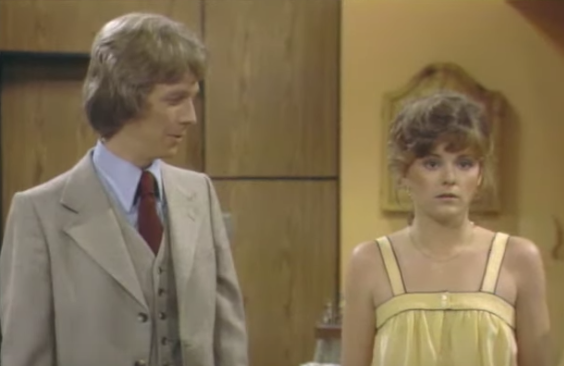
Little Miseries (OAD: November 15th, 1981, episode #440, reviewed July 7, 2019): I probably don't have to tell you why I chose this episode. Well, I'll give you four words: John Ritter and Audra Lindley! Yes, Jack Tripper and Mrs. Roper joined forces once again to add a little, ummm, insight into the human condition. The story is simple: Ritter is Frankie, a sweet confirmed bachelor who is surrounded by some seriously negative vibes that come in the guise of Aunt Carmela (Lindley) and Uncle Christopher (Edward Andrews). Carmela introduces Frankie to the lovely and seemingly happy Donna (Stephanie Faracy, who played Ritter's ex-wife in the 1990s TVM Thriller No Way Out), and the chemistry seems to be just right, only Donna is dying of leukemia and doesn't have much longer to live.

The casting of John Ritter made the news! (although this was for a 1982 rerun)

I've always be fascinated with the many different ways you can give such dark moments of our lives a lighter touch, and Little Miseries, which was written by Ben Elisco (whose only other writing credit was for WKRP in Cincinnati), manages to tackle a really tough issue with a sense of hope and even sweetness. Frankie's relatives live in a "gloom" (as Frankie puts it), but they think that's helping him prepare for the more difficult moments in life. And that perhaps disappointment will fuel change or at least action. The dialog is a mixture of morbid humor along with some rather poignant thoughts about what the darkness is and that those who live there do so because it's easier to hide. But the introduction of Donna into Frankie's life allows him to finally see a light.


This is a lovely, but strange episode. There's a twist at the end that makes Carmela seem rather cruel. But, at the same time the discovery and confrontation of her lie allows her to open up and finally reveal why she's trying to harden Frankie. It throws the episode off a bit, but Ritter and Lindley are so good, you just want to sit back and watch. So, not perfect, but pretty darn good and worth seeing just for Ritter, who can never disappoint.


The Prisoner (OAD: May 6th, 1965, episode #140, reviewed May 26, 2019): I chose this episode because of the still image used on the upload, which features Jack Klugman wearing an eye patch and holding a puppy (see image posted above in the intro for a sample)! I guess I couldn't have predicted how moving and harrowing The Prisoner was going to be.

Klugman plays a man named Weiss, and he's spending a rainy day at the pet shop, buying a puppy. The pet store owner is named Ben (no name given in the IMDb credits), and he has come to loathe rainy days because they remind him of his time in Auschwitz. After getting into a argument with Weiss, Ben finds out that Weiss was also a prisoner at the same camp, and had associated with a man named Maximilian Kolbe (Werner Klemper playing a prisoner about 4 months before he would become Col. Klink on Hogan's Heroes!), a Polish friar who opposes the Nazis at every turn. Kolbe is constantly beaten for his rebelling and his cell mates seem to either love him or hate him for it. He plots an escape for a fellow prisoner, but when it is revealed that someone has fled Auschwitz, the Nazis decide that one of the men left behind should starve to death as punishment.


This is an intense episode, and based on real events. Kolbe was a real man who offered his life in order to save another.  The Prisoner dances fairly elegantly around the question of why a God, who is supposed to be all loving and all knowing, would let something like the Nazi uprising happen under his watch. There are no answers, only a chance to feel hope in the darkest of situations, and to maybe understand that there is still good in the world. Kolbe's ultimate sacrifice at the end allows Weiss to open his mind and heart and to also not let this experience dictate his ability to believe in a God.

An original newspaper listing for the episode

In lesser hands, this could have been really heavy handed, but the filmmakers don't offer obvious answers. And, the acting is wonderful. Klugman, of course, flourished in these kinds of one-off roles he seemed to often do on TV. Klemper is a bit of a revelation too. I didn't recognize him at first, and I'm not sure I'd really seen him in a drama before. He's deft and subtle, and his scenes with Klugman are just terrific.

I want to just pull a quote from The Prisoner that I was really taken by, and which expresses why I feel Insight is such an amazing show. At the end of the episode Weiss says to Ben, "No one can alter the truth. All we can do is seek it, find it and try to live it." Great storytelling, and a really wonderful entry into the Insight series.


When, Jenny? When? (OAD: February 1st, 1979, episode #806, reviewed April 21st, 2019): This may be one of the most famous episodes of Insight. I can see why. It's Afterschool Special all the way, and it features Maureen McCormick as a beautiful teenager whose low self-esteem has given her a notorious rep at school. This episode features Jeff East, Clark Brandon and Olive Cole, and was directed by Ted Post (Five Desperate Women, The Baby, and lots of other great movies). In terms of episodic television, Post's name is probably more aligned with The Twilight Zone, but he directed several episodes of Insight. Like he did with the 1972 telefilm Sandcastles, Post directs When, Jenny? When? with a lot of sensitivity and tenderness. Aside from tackling self-esteem, this episode also explores peer pressure, self-identity, and my favorite topic, the loneliness of difference.

Original newspaper listing
The story is told both through Jenny's (McCormick) experiences and how she recounts those experiences with her high school counselor (Cole). What I appreciate about the episode is how it shows how desperate Jenny is to be loved by giving sex freely, but the act itself is not judged (she says sex feels good and she's told she can wear white at her wedding if she wants). But it is analyzed, and Jenny realizes that if she wants to truly be loved, she has to love herself first, and that means standing up for herself. Although it has to be quickly resolved in 22 minutes or so, When, Jenny? When? is handled with taste and thought. Also, Jenny's got a great theme song which helps move things along! Overall, the Afterschool Special approach gave me all the feels. I loved it.


Sunday, October 23, 2016

Must See Streaming Movie of the Week: Mind Over Murder (1979)


Network: CBS
Original Airdate: October 23rd, 1979 

In 1979, the Golden Age of made for television horror movies was arguably in the rearview mirror, but that’s not to say that good genre TVMs weren’t on the horizon. We still had a few years to go until one of the ultimate small screen chillers, Don’t Go to Sleep (1982) traumatized anyone with a pizza cutter. And somewhere in between the classic ABC Movie of the Week and the  unexpected post-seventies classics like Sleep were some solid genre entries, many of which seemed to have fallen off the radar. Of course, incredible telefilms such as Salem’s Lot (1979), and 1981’s Dark Night of the Scarecrow are bona fide classics, but there’s plenty of little films that aired during this declining era that seem all but forgotten. Good but not great films like Night Cries (1978) and The Babysitter (1980) were finding their way to the networks, and Mind Over Murder actually falls somewhere closer to the greats, despite its relatively obscure status.


Deborah Raffin is Suzy, a model, dancer and a somewhat popular commercial actress known for her dancing hamburger spots! She’s also a touch psychic and things go all weird when she meets a friend for a drink and finds the world going hazy, eventually coming to a complete stop… except for one menacing figure who eyes her creepily from a bar stool. Mostly shrugging off the weirdness, Suzy has another “vision,” later that same night, this time while watching an egg slowly roll out of the fridge, smashing on the kitchen floor. The voices and rumbling sounds accompanying the cracking egg eventually leads her to believe she predicted the terrible plane crash that becomes front page news on the next day’s morning paper.


Her arguably adorable boyfriend (and live in mate) Jason (Bruce Davison) becomes far less loveable when he refuses to put any weight into Suzy’s creepy phantasms, even after she’s able to prove that the voices she heard during the infamous egg incident belong to the doomed crew in the cockpit. Luckily, she’s met Ben (David Ackroyd), a handsome flight investigator who sends her to Dr. Povey (Christopher Cary). His psychic research suggests that Suzy is somehow going to make a physical connection with whoever sabotaged the plane… and maybe he’s creepy and bald, just like the guy Suzy saw at the bar. What she doesn’t know is that the killer is as in tune to her as she is to him, and he’s getting closer to her each day.


Shot under the title Are You Alone Tonight, Mind Over Murder is weird. The psychic visions are off-putting and eerie, and Andrew Prine as the above referenced crazy guy is freaking terrifying. When a very sweaty and crazy-eyed Prine, listed in the credits as the “Bald Man” kidnaps Suzy and attempts to entice her by flexing his wiry and lean muscles (no joke), it’s strangely effective in its gross factor (and I never thought I find Mr. Prine icky). In fact, the kidnap scenes make up most of the last quarter of the film, and there are near rapes, punchings and other uncomfortable moments that could have very well derailed an effective thriller but work because the talented actors put you in a terrifying world without resorting to exploitation tactics.


Yes, as this is a TV movie, it is (thankfully) quite restrained, although it remains gripping throughout. The overall film is suspenseful and unsettling and written in a way that makes Suzy incredibly likeable and reasonable despite her outrageous situation. The late Raffin was always a strong leading lady, and she brings just as much sympathy to her character here as she did in Nightmare in Badham County, both of which feature the actress in really dark and seemingly impossible situations.


Ackroyd is fantastic as well, and makes a great love interest for Raffin. Their blossoming romance doesn’t deter from the psychic focus of the film, but it provides a nice break between all the bleak and peculiar. Also, Robert Englund shows up as Ackroyd’s workmate, making me wonder if The Bald Man vs. Freddy Kruger could ever be a thing. Ah, to dream!


Director Ivan Nagy also made the excellent but also difficult to watch A Gun in the House (1981), and the decent thriller Jane Doe (1983) before he moved into adult films with titles such as Trailer Trash Teri and Izzy Sleeze’s Casting Couch Cuties. Oh my! He was also associated with Heidi Fleiss and served time for bookmaking. His infamy might outlive his small screen merits, but he did turn in some solid little TVMs in his day. Mind Over Murder is one such film.

Mind Over Murder is currently streaming on Amazon Instant Video. Watch it!!! 

Monday, August 10, 2015

Must See Streaming TV Movie of the Week: The Classic Edition!


Holie Molie! Two incredible early seventies Movie of the Weeks are currently streaming over at Shout Factory TV! You can check out Gargoyles and Born Innocent for free! Of course, I don't have to go into why you should see or revisit these incredible movies, so I'll just throw out a couple of links along with a few words:


Gargoyles (1972): This ABC Movie of the Week is a spooky monster classic, featuring Bernie Casey as a terrifyingly suave gargoyle who thinks mankind places second in the chain of command! Click on title for my review, and click here to watch Gargoyles!


Born Innocent (1974): This brutal classic made its debut under the NBC World Premiere Movie moniker, and was the most popular made for television movie to air in 1974. However, it was followed by controversy and subsequently became the subject of a court case involving the rape of a nine year old girl. Yet, despite the negative attention, Born Innocent remains part of the canon of the small screen thanks to its relatively unflinching look at innocence lost and a corrupt juvenile rehabilitation system. Click here to watch Born Innocent.

And thanks to Kindertrauma for mentioning Shout Factory's streaming site yesterday. They also have some great non-TVM choices, but seriously, who wants that?!? Regardless of what you end up watching, please support legitimate streaming websites and enjoy!


Thursday, May 7, 2015

Must See Streaming TV Movie of the Week: Betrayal (1974)


Network: ABC 
Original Airdate: December 3, 1974 

A Griftin’ n’ a driftin’. 

That’s the game Jay (Sam Groom) and Adele (Tisha Sterling) are into. And, while I wouldn’t recommend that lifestyle for everyone, it seems to be paying off for the dangerous couple.


The Scam: Adele (or Gretchen as she is known elsewhere) finds lonely old ladies who need some help around the house, and worms, er, warms her way into their good graces, and then Jay steps in and holds the woman hostage until they pay for their freedom. While this scares the bejeezus out of most of their victims (and leaves them broke), it turns deadly when Eunice (the great Lucille Benson still being accidentally funny in a serious role) realizes that the couple are in cahoots. After they off the old lady, the stakes are raised, and the next payoff is looking rather good when Adele hooks up with Helen Mercer (Amanda Blake), a self-made woman who needs someone to help her handle her business affairs. However, things take yet another turn when Adele comes to look up to, and like, Helen, and now she wants out of the game for good.


Based on the novel Only Couples Need Apply by Doris Miles Disney (she also wrote the novel that the excellent TVM Do Not Fold, Spindle or Mutilate was based on), Betrayal was just one of four small screen features that Gordon Hessler directed in 1974! It’s not my favorite of this batch, but I thought Betrayal was quite good, with a few truly suspenseful moments and strong acting from both Sterling and Blake. Like a lot of Hessler’s television films, Betrayal is small in almost every sense of the word. Small cast, limited locations, and light on subplots, this telefilm is brisk, if a bit insubstantial, and is a decent way to spend 74 minutes.


However, what I tend to enjoy most about a Hessler joint is the atmosphere, and that’s largely missing from Betrayal. It certainly would have benefited from a little more mood and perhaps a bit more tension. But, it does its best to keep things ticking, and the story is helped along through the formidable Blake in her TV movie debut.


Yessir, after nineteen years as Miss Kitty on the forever-running Gunsmoke, Blake decided it was time to hang up her bar wench gear, but was far from retiring. It took her only three short weeks after leaving the series to sign up for Betrayal. The actress maintains an air of strength and integrity and it’s easy to see why troubled Adele starts to look outside of a life of crime. Helen, who… in an interesting twist… has also killed before, is at a different but somewhat similar crossroads as Adele. So, while she is unaware of their deeper connection, Adele is not and it’s understandable why the two click so quickly.


The rest of the cast is great, with Groom putting in an especially sleazy performance as the suave but violent Jay, who, despite his own grave circumstances, has the last, morbid laugh.
  
Not to be confused with the same titled 1978 TVM starring Sterling lookalike Lesley Ann Warren, Betrayal is currently streaming on Amazon Instant Video and is available on DVD.

Tuesday, February 17, 2015

Must See Streaming Movie of the Week: The Third Girl From the Left (1973)

 
Network: ABC
Airdate:
October 16th, 1973

Peter Medak is my favorite director that I never talk about. He has moved effortlessly from the big to small screen, and is behind so many films I absolutely adore (The Changeling, The Krays, The Babysitter… lots of movies starting with the word The). Very early in his career the Hungarian born director was offered a chance to direct both Kim Novak and Tony Curtis in their telefilm debuts. He does not disappoint, and The Third Girl from the Left (which is songwriter Dory Previn’s lone screenplay) is an exquisite and poignant look at how even in the fast lane, life can pass you by.


The main credit sequence fixates an almost fetishistic lens on Novak as she applies her makeup. Despite being an already beautiful woman who transforms herself into an idealized knockout in a matter of seconds, there is a definite sense that Novak’s character Gloria is an unhappy woman in an unhappy place. Even though she is the “number one showgirl” in New York, she works in a small revue and has to deal with younger dancers who constantly vie for her coveted spot. In this respect, the title reflects a sad anonymity for a well-known showgirl, because despite her small grasps at fame she remains a somewhat undistinguished figure languishing in the dying (and decaying) NYC chorus girl circuit.


Previn wrote the script based on her own experiences as a struggling chorus girl. She said in an interview, “The girls never have names. The choreographer says, ‘Third girl from the left, you’re out of step.’ Some try suicide. In my album, Mary C. Brown and the Hollywood Sign, the starlet jumps off the letter H because she didn’t become a star… I wonder about our planet. Is it a lonely little starlet out in the sky? What happens when youth is gone?”


Now, in 2015, the telefilm evokes memories of last year’s Oscar’s, where Novak’s face became the object of derision, criticism and outright bullying. In this context, Third Girl takes on an extra layer of poignancy as we see Gloria as a woman whose age is quietly critiqued by everyone, including herself. She is constantly touted as a “relic” who is seen as either the stereotypical “good girl” that her philandering comedian boyfriend (Tony Curtis) puts on a pedestal while still managing to ignore her, or, in one of the film’s bluest moments, she is relegated as a celebrated antique by a group of young partygoers who only see her as the last of the great chorus girls. All, except for David (Michael Brandon, who would fall in love with Novak during production and spend the next year as her boyfriend), a young delivery boy who is clearly smitten. The two embark on a sad affair. Not sad in any kind of visibly tangible sense, but tragic in that it becomes obvious that he is also not the right guy for a girl who desperately needs the right guy.


There’s some heavy-duty stuff happening in Third Girl, but while a melancholy permeates every frame, the film never overwhelms itself with gloom. Novak is a stunner as Gloria the dejected dancer. The actress came out of a self-imposed four-year absence from acting, stating later that she liked the idea of working in television’s fast paced production atmosphere, while also bemoaning that “There’s too much time wasted in features.” And then, probably after she realized the hectic pace and the temporary life of the telefilm, she added later with some humor, “It sounded like a good idea at the time.”


Heartbreak is the name of Gloria's game and Novak keeps her sympathetic and easy to root for. Previn’s script is very of its time, and she even contributes a wistful folk song about the protagonist (which you will either love or hate, it’s that kind of tune). Produced by Playboy Pictures, Hugh Hefner cast his then-main squeeze, Barbi Benton in a small part as Curtis’ no nonsense mistress. It’s an early role, but she’s already commanding the lens and is one of the more memorable supporting characters.


Third Girl is also a wonderful, if bittersweet, time capsule, capturing the last days of the showgirl, the not-too-hard-knock-life of the Vegas comedian, the dark, grimy streets of New York, and some fantastic not very over the top seventies wear, which Novak wears with style. Whether they knew it or not, Previn, Medak and company composed a love letter to a time that feels too far away now, and despite the less than happy ending, Third Girl is a unique kind of treat and worth a look.


Third Girl From the Left is available on DVD and is currently streaming on Warner Archive Instant.